News
Quilaban and RocGene tour the country to promote innovation in rapid molecular diagnostics
Quilaban
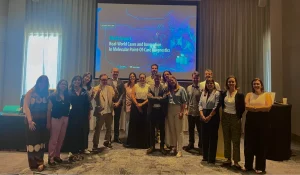
The initiative brought together laboratory visits, demonstrations of the iFIND solution and a Quilaban Academy, promoting knowledge sharing and direct contact with healthcare professionals across the country.
Over four days, Quilaban and RocGene developed an initiative dedicated to rapid molecular diagnostics (PoCT), visiting several healthcare institutions from North to South of the country. The objective was to present the iFIND solution, promote technology demonstration in real context and discuss current challenges of molecular diagnostics with healthcare professionals and laboratory teams.
The initiative featured the participation of Dr. Young Yun, Chief Business Officer of RocGene, and Dr. Xinyi Zheng, Field Application Specialist. During their time in Portugal, visits were made to Hospital de Santo António, IPO do Porto, Grupo SYNLAB, ULS de Coimbra, ULS de Leiria, Hospital Dona Estefânia and ULS Loures-Odivelas, providing moments of direct contact with clients and scientific knowledge sharing.
Halfway through this journey, Quilaban Academy was held at Hotel Eurostars Universal Lisbon, under the theme “iFIND’s Impact: Real-world cases and innovation in Molecular PoCT Diagnostics”. The meeting brought together around 50 participants and featured RocGene experts, Quilaban professionals and medical pathologists using iFIND technology.
Throughout the session, real cases of clinical use were presented, current needs of laboratory practice were discussed and the features of the iFIND system were demonstrated. The programme included testimonies from Dr. Leonardo Carneiro, from ULS Almada-Seixal, and Dr. Luís Silva, from ULS Santo António, as well as a practical demonstration of the equipment conducted by Quilaban’s Applications team.
By bringing together suppliers, doctors and laboratory teams in the same context, this initiative created a space for dialogue around the real needs of laboratories and the potential of rapid molecular diagnostics in clinical practice. The combination of practical demonstrations, clinical experience and direct contact with users continues to be an important element to bring innovation closer to the reality of healthcare services and support the adoption of increasingly differentiating solutions.